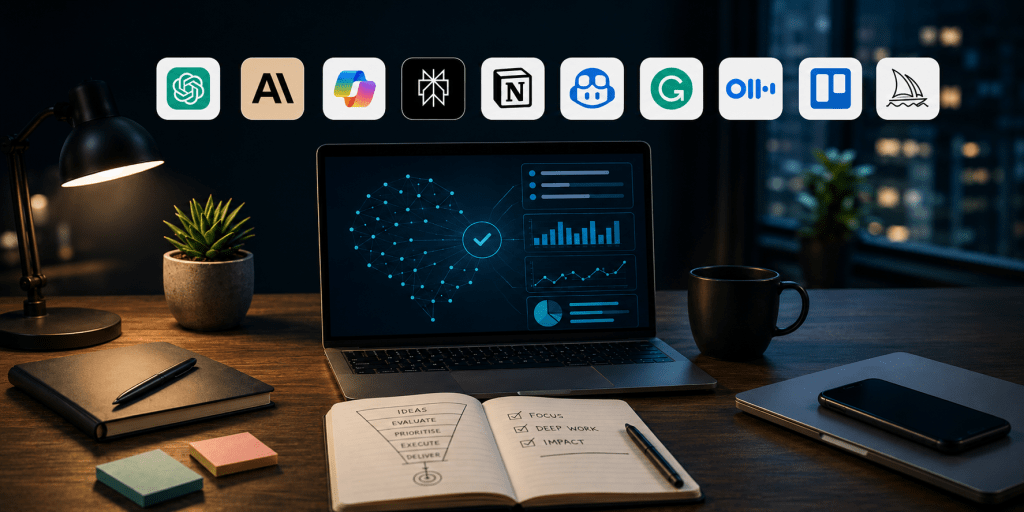
There is a version of this article that lists every AI product that launched this year and gives each one a star rating. This is not that article. What follows is the shortlist, the tools that are open on my screen on a regular working week, what I actually use them for, and where they fall short. No hype. No affiliate links I can’t stand behind.
The honest context first
I work across transformation, programme delivery, PMO governance and technology strategy, roles where using the right tools efficiently isn’t optional, it’s how the work gets done. My use cases are: structuring complex thinking quickly, processing meeting outputs, drafting stakeholder communications, sense-checking investment decisions and business cases, and researching topics I need to get up to speed on fast. Your mileage will vary based on your role.
ChatGPT Plus
Still my primary thinking tool. I use the GPT-4o model for: structuring reports and governance papers, rewriting dense prose into plain English for executives, sense-checking project risk registers, and generating options when I’m stuck. The o1 reasoning model is genuinely useful for complex dependency analysis, it thinks before it answers.
What it isn’t: a replacement for domain knowledge. You still need to know what good looks like to evaluate what it gives you.
Notion AI
I moved my knowledge base to Notion about two years ago. The AI layer added on top has changed how I use it. Most useful feature: “ask your workspace”, querying notes, documents and meeting records with natural language. For anyone managing a complex portfolio, having a searchable, AI-queryable knowledge base is genuinely transformative.
Otter.ai
I use this for meeting transcription. It connects to Google Meet and Zoom, transcribes in real time, and produces a summary after the call. The summary quality is uneven, but the searchable transcript is the real value, being able to search “what did we decide about the budget approval” three weeks after a meeting is worth the subscription alone.
Perplexity
My replacement for Google for most research tasks. It synthesises sources and gives you a cited answer instead of ten blue links. I use it for: understanding regulatory changes quickly, researching vendors before procurement decisions, and getting up to speed on a new technical domain. The Pro version adds more sources and better models.
What I don’t use (and why) I have tried: Copilot (too shallow for complex tasks), Gemini (improving, but not there yet for my use cases), Claude for everything (strong at writing and reasoning, but I don’t reach for it as my daily driver, yet). This will change. This space moves fast.
The honest summary
AI tools don’t make you better at your job. They make you faster at the parts you’re already good at, and they expose the parts where you’re unclear in your thinking. If you give a vague brief to an AI, you get a vague output. The discipline of being specific is the actual skill.
Start with one tool. Use it properly for a month before adding another.

 UserGenix