
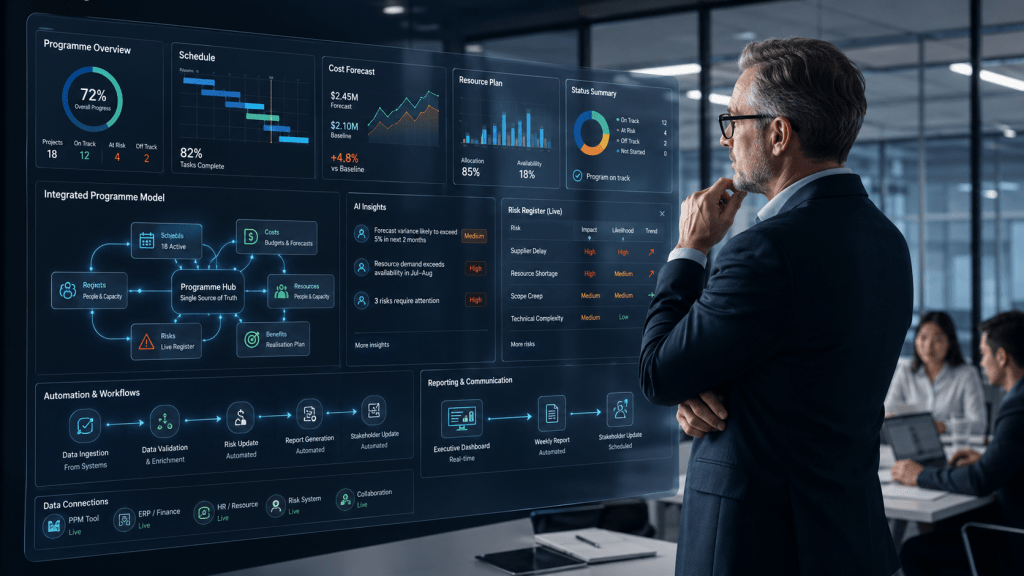
The PMO has always been a data-intensive function. Schedules, cost forecasts, risk registers, resource plans, status reports. The challenge has never been a shortage of information. It has been making sense of it fast enough to be useful.
That challenge is being fundamentally reshaped by digital tools and artificial intelligence. Not in a distant, theoretical way. Right now, in live programmes, the way project controls are operated, the way reporting is produced, and the way decisions get made is changing. The PMO leaders who understand this shift and lean into it will be significantly more effective than those who do not.
What digital PMO actually means
Digital PMO is not about using software. Every PMO uses software. It is about using the right combination of tools, data architecture, and automation to create a programme environment where information flows reliably, reporting happens with minimal manual effort, and the people running the PMO spend their time on analysis and insight rather than data gathering and reconciliation.
In practice this means connected systems rather than isolated tools. A scheduling platform that feeds into a reporting dashboard automatically. A risk register that is live rather than updated once a month before a governance meeting. A cost management system that gives programme leaders a real-time view of where spend is tracking against forecast rather than a picture that is already two weeks old by the time it reaches them.
The goal is not to replace human judgement. It is to give human judgement better and faster information to work with.
The automation opportunity
One of the areas where I have direct experience is in introducing automation into delivery pipelines, and the lessons from that work are directly applicable to the PMO context.
Earlier in my career I led the introduction of test automation and CI/CD practices into a technology delivery environment. At the time, the team was spending days on repetitive regression testing. The work was necessary but it was consuming capacity that could have been directed at higher value activity. Introducing automation did not reduce the need for skilled QA professionals. It freed them to focus on the work that actually required their expertise: exploratory testing, quality strategy, and the kind of judgement that a script cannot replicate.
The same logic applies to PMO functions. There are tasks that currently consume significant time in most PMO teams that are candidates for automation: data aggregation from multiple sources, status report generation, schedule variance analysis, risk scoring updates. Automating these does not make the PMO team redundant. It makes them more powerful because they can spend their time on interpretation, challenge, and decision support rather than administrative assembly.
Where AI is starting to make a difference?
Artificial intelligence is beginning to change what is possible in programme delivery in ways that go beyond automation of existing tasks.
Predictive analytics can identify patterns in programme data that human reviewers would miss or spot too late. Which types of risks tend to materialise in programmes of this type and scale. Where schedule slippage in one workstream is likely to create downstream impact. Which cost categories historically diverge most from forecast in the middle phase of a programme. This kind of insight, surfaced early, gives programme leaders the ability to intervene before problems become crises rather than after.
Natural language processing is starting to make it possible to extract structured insight from the unstructured data that programmes generate in enormous quantities: meeting notes, email threads, status updates, lessons learned documents. Information that currently sits in documents nobody has time to read could, with the right tools, become part of the programme’s active intelligence.
Reporting and narrative generation is another area where AI tools are beginning to add genuine value, not by replacing the programme professional’s judgement about what matters but by dramatically reducing the time it takes to produce a first draft of a report that can then be reviewed, refined, and signed off.
The human side of digital transformation in PMO
None of this works without people who are willing to change how they work. And that is where the real leadership challenge sits.
In my experience, the resistance to digital and AI-enabled ways of working in programme environments is rarely about the technology itself. It is about trust, familiarity, and the very human concern that if a machine can do part of your job, your value is under threat.
The leaders who navigate this well are the ones who bring their teams on the journey rather than imposing the destination. Who are honest about what the tools can and cannot do. Who invest in developing the skills their teams need to work effectively in a more automated environment. And who make clear that the goal is to make good people more effective, not to replace them.
Where I stand on this
Digital PMO and AI-enabled delivery is an area I am genuinely excited about and actively developing. My background in technology and transformation means I am comfortable in the space where delivery meets digital capability. I understand how automation works in practice, not just in theory. And I have seen firsthand what happens when you give skilled professionals better tools and free them from low-value manual work.
What I am focused on now is developing a clearer point of view on how these capabilities apply specifically in infrastructure, capital programmes, and regulated sector delivery, environments where the data volumes are significant, the governance requirements are demanding, and the opportunity to use digital tools more effectively is substantial.
That is the conversation I want to be part of. And it is one I expect will define what excellent PMO leadership looks like over the next decade.
How is your organisation approaching digital and AI-enabled capabilities in programme delivery? I would love to hear what is working, what is not, and where you think the real opportunities sit. Drop a comment below.

 UserGenix